
Introduction
Many OEMs are seeking ways to help drivers learn their car’s features more easily. And that’s sensible: according to surveys, users often find them confusing, misunderstand their purpose, or don’t even know they exist. Still, some of these capabilities could make everyday trips safer or more convenient.
In practice, OEMs have two main ways to address the problem:
- Extend their own built-in voice assistant – existing or planned – to support feature guidance. For example, by integrating and training an AI model.
- Integrate a separate onboarding solution.
In this article, we compare both approaches and explore why a standalone option can be a more reliable, business-smart choice.
To illustrate, we use IVO – an AI-powered onboarding system designed to surface advanced functions often overlooked by vehicle owners. Beyond just discovery, IVO clarifies each feature’s purpose, shows its location via visual instructions on the car display, and helps ensure its correct and timely use while driving.
A specialised system, not a general assistant
IVO is an addition to the existing system, not a replacement; it can be delivered as an infotainment or mobile app. Thus, the OEM’s core assistant continues to handle standard commands like navigation, media, and climate control. IVO, in turn, focuses only on two specific tasks:
- explaining how to use vehicle features via voice guidance in the infotainment app or AR guidance in a mobile app;
- providing driving assistance through contextual prompts during the trip and answering driver questions.
Why does this require a dedicated solution?
General-purpose assistants are typically designed around common feature use cases and provide generic explanations. IVO, by contrast, delivers insights tailored to a specific vehicle configuration, including exact control locations and activation steps.
This specificity is combined with proactive feature recommendations. How does it work?
With a standard voice assistant, a driver can ask about the weather, news or just common questions about vehicle usage. With IVO, drivers get more customised, in-depth, and proactive tips on even the most advanced features of their car. This is achieved using machine learning algorithms that continuously analyse the vehicle, its surroundings, and user behaviour. As a result, the system can automatically suggest enabling, say, lane assist when the driver enters a motorway.
A focused voice mode, distinct from everyday commands
You might be thinking: wouldn’t a second voice assistant confuse drivers?
With IVO, that risk is minimal.
The product runs as a standalone app. When it’s open, its voice interface is active, while the OEM’s core voice assistant remains in the background.
When the app is closed, IVO stays inactive and responds only when explicitly invoked by the user – similar to how Siri works on iPhones. This helps minimise potential conflicts between voice interfaces.
In practice, this clear split can be beneficial.
Using a single system to both control and explain vehicle functions creates ambiguity. The assistant must constantly infer, say, whether the user wants to operate a feature or learn about it.
This can lead to unnecessary follow-up questions and driver distraction – running counter to core automotive HMI safety principles.
By separating responsibilities into two distinct systems, user intent becomes clearer for each.
Structured, adaptable guidance beyond standard GenAI
Tools like Gemini and ChatGPT are impressive, but integrating them into in-vehicle voice assistants can come with significant practical challenges.
First, it’s difficult to fully control what the model can answer and which sources it can use in safety-critical situations.
Second, many GenAI-based solutions are cloud-dependent. This makes offline operation harder and increases the need for safeguards against outages and hallucinations.
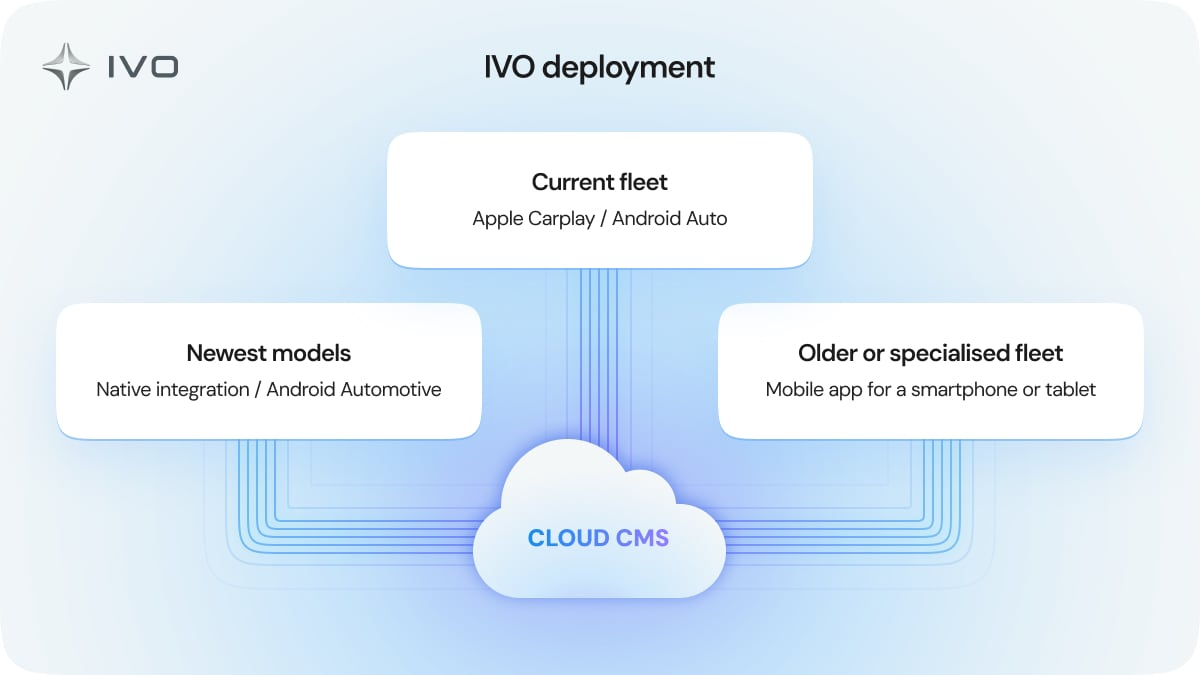
Finally, deep LLM integration is still more common in newer vehicles and is built for native head units. This makes consistent onboarding harder in mixed fleets with older vehicles, where smartphone-based integration may be the only option. For example, in car-sharing.
IVO provides a different approach. Its built-in content management system gives OEMs full control over user guidance: from text, images, and video to fine-grained voice assistant configuration.
In addition, the solution works offline and supports Apple CarPlay and Android Auto, keeping onboarding flexible and reliable – whether through the in-vehicle system or on the driver’s phone.
Fast to deploy, with no complex engineering required
IVO is designed for straightforward delivery through existing OEM platforms. In most cases, integration focuses on configuration and UI/UX rather than deep system changes, reducing overall deployment time.
Currently, the product supports Android Automotive OS. It also works with iOS and Android smartphones and supports Apple CarPlay and Android Auto, so it can easily be connected to a compatible infotainment system. When needed, the solution’s architecture also allows connection to other infotainment platforms, including proprietary ones.
Designed to support OEM UX, not replace it
It’s easy to understand OEMs’ desire to fully control the user experience. Building a solution from scratch is often seen as the most reliable way to achieve it. But it’s also the most expensive path.
IVO does not impose fixed usage patterns. It can be delivered as a white-label, combining shared intelligence from Bamboo Apps with a UI/UX fully defined by the OEM team.
Therefore, IVO becomes a natural part of the OEM ecosystem at a lower cost than a custom build.
Tangible business benefits
Investing in a purpose-built onboarding solution may seem hard to justify at first. It’s often viewed as a usability concern rather than a strategic business capability.
As noted earlier, IVO goes beyond simple feature introduction. Yet even in its core role, it delivers direct business value – for three key reasons.
1. Brand loyalty
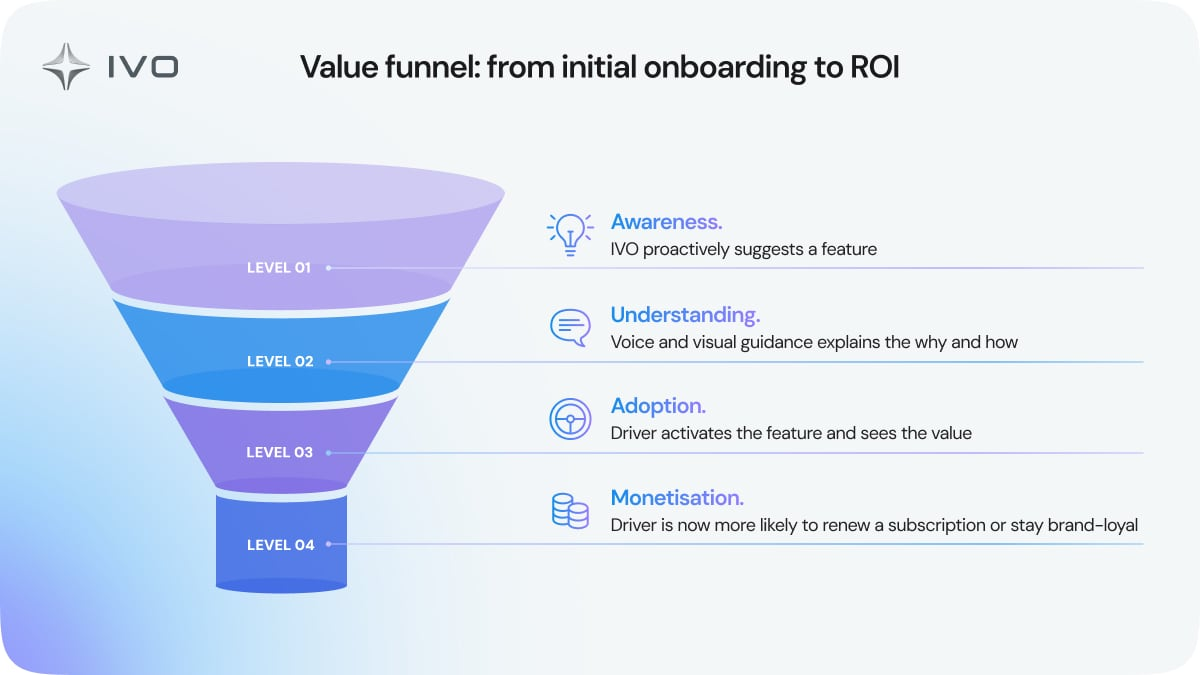
Early ownership plays an essential role in shaping brand perception. Research shows: drivers are more likely to return to OEMs whose vehicles are easy to understand and use. By contrast, friction with key features can quickly drive customers away, even if the brand itself has a good reputation.
This risk is material: more than half of motorists report dissatisfaction with their current brand and plan to switch within 6–18 months.
A smoother learning experience helps prevent negative first impressions and supports retention. A critical advantage in an industry where OEMs have limited opportunities for direct client interaction.
2. Feature and subscription adoption
Many vehicle owners are interested in premium features, particularly safety-related ones (e.g., blind-spot monitoring, adaptive cruise control). However, this interest does not always translate into willingness to pay – often due to practical reasons:
- unclear benefits;
- difficulty finding them within the infotainment system;
- uncertainty about when and how they should be used.
As a result, some in-demand capabilities such as ADAS are often discovered through trial and error. In turn, less prominent ones like traffic sign recognition may go unused, even when offered for free.
IVO addresses this awareness gap by clearly explaining the purpose and usefulness of features. This helps drivers make more informed decisions about built-in and paid options, supporting higher activation rates.
3. Lower support load and reduced reputational risk
By answering common questions directly in the vehicle, IVO helps reduce routine support requests. Clear guidance also lowers the risk of misuse, helping prevent unnecessary wear or safety incidents.
Thus, OEMs benefit from both direct operational savings and reduced indirect costs related to brand perception.
Onboarding tailored to your industry and vehicle segment
IVO supports guidance not only for passenger cars, but also for trucks, recreational vehicles (RVs), and other specialised commercial vehicles. This makes the product suitable for highly specialised industries.
For example, the application can support rapid orientation in logistics, where drivers often switch employers and vehicles. It can also warn of unsafe actions for the user or cargo – use cases that basic assistants are not designed to handle. And in rental scenarios, it can help users get familiar with an RV quickly.
Conclusion
As we can see, structured onboarding is more than an extra UX capability. It’s a business lever that requires a dedicated, controlled approach. IVO performs convincingly in this role, strengthening the core system rather than competing with it – in a way drivers value and OEMs benefit from.
Let’s discuss how IVO could support your vehicle lineup and business objectives. Book a consultation to learn more about Bamboo Apps’ experience and evaluate integration options.